Showing posts with label plants. Show all posts

13 October 2014

pigments&paints workshop


this is a workshop for the radical self-reliant artist: make your paints from sratch! all you need is terracotta bricks, egg and water! 
egg tempera paint has widely been forgotten because it can't be preserved (meaning can't be mass produced and sold). used by monks in the medieval times to paint the elaborated initials of bible transcriptions, it is a highly resistant paint that makes beautiful bright colours when applied in layers. recipe here: http://wunderkinderhongkong.blogspot.hk/2013/08/mix-it-yourself.html


discovering bricks and clays: 
there are endless variations of the colour 'burnt sienna': bricks found on the beach, ground into powder and bound with egg yolk, using water as a thinner. and the hues and tints of clays found in south lantau: ground into powder with a mortar and bound with egg yolk, using water as a thinner. 
further reading on 'burnt pebble beach red': http://liinaklauss.blogspot.hk/2013/03/burnt-pebble-beach-red.html


discovering plants:
the bright red flowers of 'sleeping hibiscus' (bot. malvaviscus) make a beautiful purple tone. leaves of malvaviscus when crushed in a mortar make a slimy green substance that can be applied directly onto paper without water nor binder. the leaves when mixed with water have the same quality as soap: foamy and slimy, they can serve as hair conditioner or shampoo. and as if that is not enough the petals of the malvaviscus flower are edible and make a highlight to every salad or desert!

you find more of my thoughts about colours here: http://liinaklauss.blogspot.hk/2013/03/the-real-thing.html

for further reading on the subject of making your own paints please refer to the following literature:
Cennino Cennini: 'The Craftsman's Handbook' / 'Il Libor dell'Arte' witten in the early 15th century, cennini reveals the secrets of the painter guilt with detailed instructions for egg tempera, under paintings, coatings etc: highly recommendable!
Victoria Vinlay: 'Colour' written by a SCMP journalist, vinlay tells personal stories as well as historical facts of paints and how they were invented, discovered, traded and used: good read!


mind-your-head


'mind your head' is my workshop contribution to imagine peace festival 2014 on lantau island, hongkong. we let ourselves be inspired by the extravaganza of nature and create head-pieces made from the beauty that surrounds us: lush leaves, green grass, fresh fruit and flowers. and off we go to find all of these adornments on our walk along the beach and through the beautiful wetlands of pui o. apart from natural objects we find bottle caps, fishing nets and a lot of broken down pieces of plastic. we take our findings and turn them into bouquets on each other's heads, just like children adorn each other. it is an act of giving and receiving. by adorning our heads with beauty of the natural world and the throw-aways of the human society, our heads are decorated on the outside. on the inside we start to think: why is there so much rubbish in nature? where does it come from? where does it go to? questions like children ask. honest questions hard to find a simple answer to. 

 the process of adorning each other with the treasures of nature honors ourselves and is a deep prayer to the beauty of mother nature herself. let her be healed. and let us heal within her.


6 October 2013

Botanical drawings: Wild Chinese Pineapple


This plant with its spiky leaves and round fruits grows on beaches in Hong Kong. Its name is Wild Chinese Pineapple or Screw pine (lat. Pandanus) and it has an important role in keeping the sand and soil from being washed into the ocean. Parts of the fruit can be found in the sand and they look very pretty,almost like little brushes. See, a couple of them even germinated in my garden! So with this background knowledge and a big green Wild Pineapple in front of them, the children start to draw. It is a difficult task as the surface is made up of an intricate and repeating pattern. How patient they copy each seed and how beautiful those drawings turn out! I am once again very proud of my little artists:-)


16 September 2013

Botanical drawings: Kadena de amor


There are so many names for this beautiful flower (bot. Antigonon): Chinese love vine, Heart on a chain, Chain of hearts and many more. We stick to its Spanish name Kadena de amor because this creeper is a native to Mexico. 
In the next couple of lessons we will explore botanical drawings. Today we start out with the heart-shaped leaves of our Kadena de amor. The frottage technique is perfect: placing the leaf underneath a thin sheet of paper and rubbing over it with a soft pencil or crayon. An easy way to do a perfect copy! Next step is to cut out the leaves with a pair of scissors. Then we draw the vine and glue the leaves onto the stem. 

So far so good. Next lesson will be all about pink flowers and butterflies:-)

6 September 2013

Kadena de amor: flowers and butterflies


It is important to me to let children draw from real nature. Today I brought out a selection of insects for them to copy. No photo can capture those transparent delicate wings and shimmering bodies appropriately. In nature children have to find their own way of observing, their own angle of looking. They themselves have to make this selection. And they themselves will reap the fruit.  

8 August 2013

Passion for plants and paints


This is an art class involving two of my favourite topics: plants and paints! 
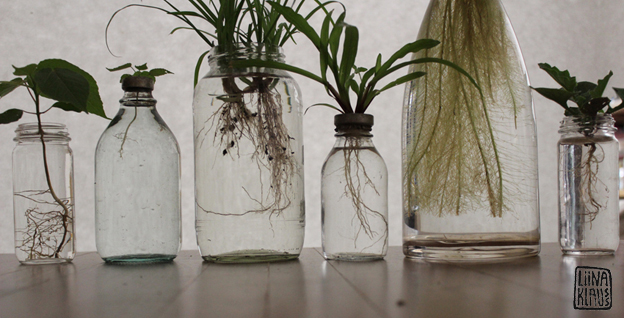
We're used to drawing plants from the ground up - but that's only half the picture, isn't it? Plants have roots which aren't less beautiful and just as diverse as the plant leaves themselves. Take a look at how well the children observed and drew their versions of the different roots and leaves. They first made a draft with pencil and then coloured the soil around the roots in, which was quite a challenge being a negative image!
Another amazing fact about these paintings is that the soil is actually painted with brown pigments retrieved from the earth, and that the leaves are actually painted with the green juice of leaves and grass! I will tell you about the recipe for these paints in my next blog entry - stay tuned:-)